Jul 3, 2014
Shop Terreform NOW!
Buy items from our on-line store today!
We have our monograph, books, models, research journals, drawings, posters,
prints, furniture, home accessories, artworks, and more for sale.
Jun 27, 2014
Aspen Ideas Festival w/ Terreform ONE
Sustainability is a good thing. But is it good enough? Join the co-founders of the Brooklyn-based design studio Terreform ONE at the intersection of design, engineering, and synthetic biology for a journey beyond sustainability. Glimpse the future of energy, transportation, infrastructure, waste treatment, food, and water as they explore the socio-ecological possibilities of New York City and solutions for urban environments like it around the world.
http://www.aspenideas.org/schedule/fest1/6-28-2014
Jun 26, 2014
Futurists Propose "Walking City" of Configurable Housing Units Christian Hubert & Mitchell Joachim
The following proposal, by the architects and futurists at Terreform ONE, was submitted for our May cover feature, in which we asked designers to envision new models of multigenerational housing. IMAGE: Nicholas Gervasi
"Multigen" will enable generations to
live together, but still preserve options to move away for any length of
time. Not only will extended families be able to live together "under
one roof," they will also have the option of combining their living
units with those of, say, their grandparents, parents, or children.
These can, in turn, be integrated into greater settlement patterns, including cities, suburbs, and rural areas.
http://www.metropolismag.com/Point-of-View/June-2014/Futurists-Propose-Walking-City-of-Configurable-Housing-Units/
Terreform ONE, OfficeUS Outpost la Biennale di Venezia
Pavilion of the United States of America at the 14th International Architecture Exhibition - la Biennale di Venezia, OfficeUS, a global collaborative architectural practice founded by Eva Franch i Gilabert, Ana Miljački and Ashley Schafer.
TEAM Outposts: Allard van Hoorn,
Anda French,
Aristide Antonas,
Austin Mergold,
Benjamin Porto,
Cara Liberatore,
Caroline Smith,
Chrissi Nasz,
Ciro Miguel,
Constantin Boym,
Daniel Tudor Munteanu,
Danielle Rago,
Doreen Adengo,
Eva Alvarez,
Fabio Gigone,
Fabrizio Furiassi,
Filippo Cattapan,
Garrick Jones,
Hanna Espinosa,
Henry Smith-Miller,
Ioannis Oikonomou,
Jean Benoit Vetillard,
Jenny French,
Jonathan Crisman,
Jorg Sieweke,
Juan Molina Restrepoe,
Kristy Balliet,
Lisa Pauli,
Luis Diego Quiros Pacheco,
Maj Plemenitas,
Maria Pilar Pinchart,
Mart Schaefer,
Matthew Messner,
Mitchell Joachim,
Nazanin Naeini,
Nick Axel,
Pablo Costa,
Pamela Ritchot,
Paolo Migliori,
Patrizia Toscano,
Paul Preissner,
Peter Macapia,
Phillip Denny,
Quilian Riano,
Ragunath Vasudevan,
Sahra Motalebi,
Samuel Stewart-Halevy,
Sara Dean,
Sasa Zivkovic,
Selma Alihodzic,
Sindy Martínez Lortia,
Stephen Mueller,
Taller de Casquería Collective,
Tamar Alon,
Ted Landrum
May 29, 2014
Terreform ONE Is hosting IaaC Global Summer
The IaaC students will join us this summer for two weeks of intense exploration at the Brooklyn Navy Yard. http://www.iaac.net/educational-programms/the-next-city-2014-43
Maria Aiolova at Water Week NYC
Maria Aiolova presented Terreform ONE's vision for the NYC Waterfront. With Mayor Dawn Zimmer and David Rockefeller Jr.
http://www.inventropolis.com/waterweek-nyc/
May 22, 2014
May 19, 2014
Mitchell Joachim, Terreform ONE, The Atlantic NY IDEAS
The Atlantic and the Aspen Institute's New York Ideas talk with Mitchell Joachim of Terreform ONE, A Tree Grows Under Manhattan.
http://www.theatlantic.com/live/events/new-york-ideas/2014/#event-speakers
Apr 24, 2014
Weltstadt - Who creates the city? Mitchell Joachim Terreform ONE, Berlin
New Civil Society: Stagnation in climate policy, vacant properties in the post-industrial
city, privatization of public spaces and displacement of socially
vulnerable people from the city. Increasing numbers of citizens no
longer intend to wait and are taking their future into their own hands.
They are repurposing abandoned buildings, trying out resource-saving
ways of life and they are demanding their right to the city. How is the
self-organization and horizontal linkage between these civil-society
actors succeeding?
Davis Kanepe, Cultural Activist, Kanepes Cultural Center, Riga
Mitchell Joachim, Architect and Professor, New York University
Purev-Erdene Ershuu, Architect and Lecturer, Mongolian University of Science and Technology
http://www.daz.de/sixcms/detail.php?object_id=&area_id=34&id=12659193&template_id=46&lang=en
Davis Kanepe, Cultural Activist, Kanepes Cultural Center, Riga
Mitchell Joachim, Architect and Professor, New York University
Purev-Erdene Ershuu, Architect and Lecturer, Mongolian University of Science and Technology
http://www.daz.de/sixcms/detail.php?object_id=&area_id=34&id=12659193&template_id=46&lang=en
Apr 20, 2014
Future City Berlin
Symposium on Speculative Design Practices and Heterodox Pedagogy: with Maria Aiolova, Sarah Whiting and Matthias Bottger.
Sponsored by: Terreform ONE, Deutsches Architektur Zentrum (DAZ) and CIEE.
Apr 7, 2014
ONE Prize 2014 Competition Launched - Smart Dock!
see here:
http://oneprize.org/
Apr 1, 2014
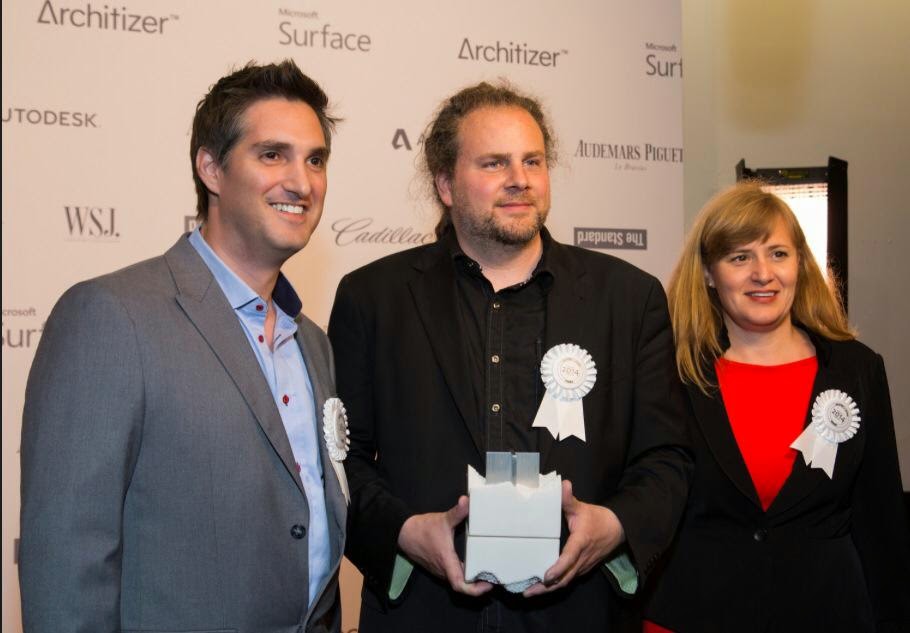
A+ Award Popular Choice Winner, Terreform ONE
Nurhan Goktur, Mitchell Joachim and Maria Aiolova at the A+ Award Ceremony.
Our project; BIO CITY WORLD MAP OF 11 BILLION is the A+ Award Popular Choice Winner in the Plus Categories | Architecture + Communication.
This
is an unparalleled honor. With entries from over 100 countries, this
work truly represents the best of architecture worldwide. The Architizer
A+ Popular Choice Winner is selected by the online voting public after a
three week long campaign.
Mar 26, 2014
BBC Future Building Tomorrow Exhibit with Terreform ONE
id
you know that by 2050, 7 out of every 10 people will live in a large
city? Check out how BBC.com proposes we work today to transform our
cities for a better tomorrow. The Building Tomorrow exhibit will take place at Openhouse Gallery’s 168 Bowery in April!
Openhouse Gallery’s 168 Bowery
Mar 18, 2014
VIA Festival International with Terreform ONE
Exposition Micro/ Macro, Le Manège Maubeuge, France and Mons, Belgium.
featuring:
TERREFORM ONE : BIO CITY MAP OF 11 BILLION
PHILIPPE DECOUFLÉ : HEXABOITE / MEUBLES OPTIQUES / LA GROSSE TÊTE / KRONOFOTO
ANTI VJ : 3DESTRUCT
HEATHER DEWEY-HAGBORG : STRANGER VISIONS
IKEUCHI HIROTO : DESK TURNED DIORAMA
TOM KOK & BRITT HATZIUS : MICRO EVENTS
ALAIN JOSSEAU : AL-THANIYAH DISTRICT (COLLATERAL MURDER) / COORDONNEES : 33° 18’48.524’’ N, 4°30’43.17’’ E
RYOICHI KUROKAWA : OSCILLATING CONTINUUM
CHARLOTTE LEOUZON : MICRO MACRO (sélection de films)
BRENNA MURPHY : CRÉATION
CARSTEN NICOLAI : AOYAMA SPACES
BERND OPPL : FLOCK / DELAY ROOM
BORIS PETROVSKY : DAS VERGERÄT
ANNE ROQUIGNY : 111oOzOo111 (sélection d’œuvres du web)
CANDAS SISMAN : MAKROMIKRO / CYCL
KRIS VERDONCK : MONSTER
http://www.lemanege.com/cgi?lg=fr&pag=1310&tab=111&rec=981&frm=0
featuring:
TERREFORM ONE : BIO CITY MAP OF 11 BILLION
PHILIPPE DECOUFLÉ : HEXABOITE / MEUBLES OPTIQUES / LA GROSSE TÊTE / KRONOFOTO
ANTI VJ : 3DESTRUCT
HEATHER DEWEY-HAGBORG : STRANGER VISIONS
IKEUCHI HIROTO : DESK TURNED DIORAMA
TOM KOK & BRITT HATZIUS : MICRO EVENTS
ALAIN JOSSEAU : AL-THANIYAH DISTRICT (COLLATERAL MURDER) / COORDONNEES : 33° 18’48.524’’ N, 4°30’43.17’’ E
RYOICHI KUROKAWA : OSCILLATING CONTINUUM
CHARLOTTE LEOUZON : MICRO MACRO (sélection de films)
BRENNA MURPHY : CRÉATION
CARSTEN NICOLAI : AOYAMA SPACES
BERND OPPL : FLOCK / DELAY ROOM
BORIS PETROVSKY : DAS VERGERÄT
ANNE ROQUIGNY : 111oOzOo111 (sélection d’œuvres du web)
CANDAS SISMAN : MAKROMIKRO / CYCL
KRIS VERDONCK : MONSTER
http://www.lemanege.com/cgi?lg=fr&pag=1310&tab=111&rec=981&frm=0
Mar 13, 2014
Smart Dock: ONE Lab Educational Facilities at the Brooklyn Navy Yard
2014 ONE PRIZE - CALL FOR SUBMISSIONS
ONE Lab is seeking design proposals for the Smart Dock that are both symbolic and buildable. The design should symbolize the ideas and values of ONE Lab: Interdisciplinary learning, studio-based design, collaborative space, DIY making, hacking. The Smart Dock should address the future of learning environments that inflects the trajectory of experimental design schools into the new spaces of socio-ecological design in times of climate change.
Competition entries should develop strategies for the identity for ONE Lab as the educational and public component of this vibrant center for design and science, with interfaces to state-of-the art equipment and a network of creative and entrepreneurial affiliates. We intend to build the winning entry.
http://www.oneprize.org/index.html
ONE Lab is seeking design proposals for the Smart Dock that are both symbolic and buildable. The design should symbolize the ideas and values of ONE Lab: Interdisciplinary learning, studio-based design, collaborative space, DIY making, hacking. The Smart Dock should address the future of learning environments that inflects the trajectory of experimental design schools into the new spaces of socio-ecological design in times of climate change.
Competition entries should develop strategies for the identity for ONE Lab as the educational and public component of this vibrant center for design and science, with interfaces to state-of-the art equipment and a network of creative and entrepreneurial affiliates. We intend to build the winning entry.
http://www.oneprize.org/index.html
Mar 7, 2014
Prof. Oliver Medvedik, Cooper Union
Prof. Oliver Medvedik from The Cooper Union Frontpage:
"Learn How to Sequence DNA in Less Than a Day"
Though less well known than the four degree-granting engineering disciplines -- chemical, civil, electrical and mechanical -- bioengineering has a place at The Albert Nerken School of Engineering. The practice of applying engineering principles to the life sciences happens chiefly through the Maurice Kanbar Center for Biomedical Engineering and through the Sandholm Visiting Assistant Professor of Biology and Bioengineering, a two-year position currently held by Prof. Oliver Medvedik. A native of New York City, he co-founded Genspace, a non-profit biotechnology laboratory for classroom and public use. Now into his second semester, Prof. Medvedik has begun rounding up students to attend iGEM, an annual, national synthetic biology competition. We sat down with him for a chat about iGEM, Genspace, his ambitions during his time at Cooper and why the thought of bioengineered terrorism doesn't worry him...too much."
"Learn How to Sequence DNA in Less Than a Day"
Though less well known than the four degree-granting engineering disciplines -- chemical, civil, electrical and mechanical -- bioengineering has a place at The Albert Nerken School of Engineering. The practice of applying engineering principles to the life sciences happens chiefly through the Maurice Kanbar Center for Biomedical Engineering and through the Sandholm Visiting Assistant Professor of Biology and Bioengineering, a two-year position currently held by Prof. Oliver Medvedik. A native of New York City, he co-founded Genspace, a non-profit biotechnology laboratory for classroom and public use. Now into his second semester, Prof. Medvedik has begun rounding up students to attend iGEM, an annual, national synthetic biology competition. We sat down with him for a chat about iGEM, Genspace, his ambitions during his time at Cooper and why the thought of bioengineered terrorism doesn't worry him...too much."
Mar 3, 2014
Terreform ONE Official Selection of the Venice Biennale
The Bio City Map, created by the nonprofit organization Terreform ONE, is a forecast of the world population distribution in the 25 densest cities on Earth. The map displays population density as a parametric graph on the front. The map back focuses on each of these cities, designed and grown inside petri dishes with colonies of E. Coli as a method of analog computation. This is an interdisciplinary project where architects, urban planners, biologists, sociologists, and artists were all working together to create a map of the near future of human population growth.
The Global Art Affairs Foundation, under the direction of Rem Koolhaas, has curated the exhibitions at Palazzo Bembo and Palazzo Mora as an official part of the Venice Architecture Biennale. They have selected the Bio City Map as a key component of the exhibition. The project has already been exhibited internationally at the New Institute (NAI) in Rotterdam and the Onsite [at] OCAD U Gallery in Toronto.
Mitchell Joachim, Terreform ONE Co-Founder and Associate Professor of Practice at NYU will lead a group of advanced researchers and students from NYU Gallatin School of Individualized Study abroad. According to Terreform ONE Co-Founder and CIEE Academic Director for Global Architecture and Design Maria Aiolova, “The students will have the opportunity to learn new methods of studying urban growth and interact with world renowned architects, designers and thought leaders.” Terreform ONE Partners’ Melanie Fessel, Nurhan Gokturk and Oliver Medvedik will be also collaborating closely with the students.
VISIT: Bio City Map; Global Architecture and Design.
Feb 24, 2014
Feb 13, 2014
New Book: Super Cells
Mitchell Joachim and Nina Tandon describe the tantalizing array of inventions already
being created with nature’s elemental building block: the cell. Imagine
personalized bone replacements, living condominium complexes,
bacteria-made haute couture, and top sirloin grown without a farm.
http://www.amazon.com/kindle/dp/B00ICXN3VA/ref=rdr_kindle_ext_eos_detail
Jan 30, 2014
Harvard Graduate School of Design Lecture w/ Mitchell Joachim
Jan 29, 2014
IaaC Barcelona - Winter Lecture Series 2014: Maria Aiolova
Maria Aiolova delivered the first lecture in the Winter Series at the Institute of Advance Architecture in Catalonia. http://www.iaac.net/lectures?id=246
Dec 13, 2013
Terreform ONE - Bio City Map: Biology as Computation
In the next 100 years we can expect human population to reach 11 billion people. Is this sustainable? We used the Buckminster Fuller Dymaxion Map to take a view of the world and look at the 25 densest cities on the planet. Our Bio City Map displays population density as a parametric graph on the front. The backside zooms in on each of these cities designed and built and grown inside petri dishes.
We chose colonies of E. Coli as a method of analog computation. Population density was represented in two different forms of bioluminescent E. coli under UV light. Glowing red E. coli represented future projections, while green represented existing conditions in cities. We used the dilution method in biology to show the range of densities of E. coli populations in each petri dish. Stencils derived from CAD files would shape the E. coli into specific geometries that display the current conditions in cities. This is an interdisciplinary project because cartographers, urban planners, biologists, and architects, were all working to think about a map of the near future of human population.
Dec 7, 2013
Making the Bio City World Population Map of 11 Billion
World Population in 2110
Artists: Terreform ONE
Date: 2013-14
Size: 15’ x 9’ x 3’
Media:
transgenic E. coli, parametric thermoformed styrene plates, carbon fiber rods,
steel strut channels, USB microscopes 400x, multiport high-speed USB hubs, ultraviolet
LED lighting strips, MAC Mini.
The United Nations announced: “World population stabilization unlikely this
century” (Gerland et al. 2014). In
the next 100 years we can expect human population to reach 11 billion people.
What does this increased massive growth look like? Our Bio City Map is a hybrid
art and science installation that links: transgenic design, cartography, urban
planning, and 3d parametric graphics.
We formed a world map based on the Dymaxion grid to
communicate an all-encompassing view of population density in cities based on probabilistic census data. The map
visualizes the earth as one entire urbanized place, instead of unconnected settlements,
municipalities, and disparate regions. If we are anticipating growth at this
rate almost everything in human society will be comprehensively stressed. This
systemic pressure includes: water scarcity, food shortages, overcrowding, air quality
depletion, and traffic congestion. The public must be made aware of the
consequences related to uncontrolled growth. It is the first step in
recognizing a universal challenge in this century. If we cannot foresee the impending
difficulty, the potential solutions are hard to justify.
Our Bio City Map displays population density as a
parametric graph on the front and the back is made with living biosynthetic transgenic
matter. These living elements focus on twenty-five mega-cities, genetically designed
and grown inside petri dishes. Our novel approach experimented with living
populations that consisted of billions of bacterial cells. We chose colonies of
E. coli as a method of demonstrating exponential population growth using
synthetic biology.
Population density was represented in two different
forms of fluorescent transgenic E. coli under UV light. Glowing red E. coli
represented future census projections. While green E. coli represented existing
demographic conditions you would find in today’s cities. Micro-stencils derived
from CAD files shaped the E. coli into specific geometries that display the
current geopolitical boundaries in cities.
Genetic
modifications of benign strains of E. coli were carried out at Genspace, the
world’s first community based biotech laboratory and at Terreform ONE. Genes
cloned from bioluminescent oceanic animals, such as jellyfish and coral, were
introduced into bacteria by transformation. These genes encoded information
that would enable our transformed microbes to synthesize either GFP or RFP, two
brightly fluorescent proteins. The transformed E. coli were then incubated
overnight on Petri plates containing agar based media with antibiotics, to
select our genetically modified strains. Individual bacteria divided through
repeated population doublings to produce colonies containing millions of cells.
Each selected cell now expressed our cloned proteins. We then used high-speed
centrifugation to concentrate our colonies of transgenic E. coli.
A novel method was used to produce stencil derived
bacteria prints for long-term archival quality gallery display and to underscore
the highest zones of growth. Ultimately, the
bacterial shapes grow to reveal variant patterns of transformation in urban
regions. By using biosynthetic materials, we expect to narrow the gap between
idealized mathematical interpretations and observable events in nature.
The Bio City Map is an interdisciplinary project
that involved cartographers, urban planners, biologists, and architects to
complete a manifestation of future population density. We argue that most
nations cannot view the effects of planetary population density through the
lens of just one city or region. Instead we aimed to reveal the long-range
effects of immense human growth in areas of present and speculative urban
intensity.
Credits: Mitchell Joachim, Oliver Medvedik, Nurhan
Gokturk, Melanie Fessel, Maria Aiolova.
Research Fellows: Chloe Byrne, Keith Comito, Adrian
De Silva, Daniel Dewit, Renee Fayzimatova, Alena Field, Nicholas Gervasi,
Julien Gonzalez, Lucas Hamren, Patty Kaishian, Ahmad Khan, Laasyapriya Malladi,
Karan Maniar, Ricardo Martin Coloma, Puja Patel, Merve Poyraz, Mina Rafiee,
Mahsoo Salimi, Manjula Singh, Diego Wu Law.
Our team consisted of a consortium of individuals
trained and/or working at the Harvard University Medical School and GSD, MIT
Media Lab, NYU Gallatin, Cooper Union, and the nonprofit organizations of
Terreform ONE and Genspace.
______________________________________________________________________
*The United Nations (UN) recently released population projections based
on data until 2012 and a Bayesian probabilistic methodology. Analysis of these
data reveals that, contrary to previous literature, the world population is
unlikely to stop growing this century. There is an 80% probability that world
population, now 7.2 billion people, will increase to between 9.6 billion and
12.3 billion in 2100.
Gerland,
Patrick, et al. “World population
stabilization unlikely this century.” Science, Vol. 346 no. 6206 (10 October 2014) pp. 234-237.
Subscribe to:
Posts (Atom)


.jpg)